

Table of Contents
- Understanding Pigmentation and Why It Returns
- How Regenerative Skin Therapy for Pigmentation Works
- Benefits of PRF Over PRP for Pigmentation
- How Long Does PRF Treatment Take?
- Post-Treatment Care for Regenerative Skin Therapy
- Comparing Regenerative and Traditional Laser Approaches
- Is Regenerative Skin Therapy Right for Your Skin?
- Frequently Asked Questions
Last Updated: September 22, 2026
Understanding Pigmentation and Why It Returns
Pigmentation problems rarely stay solved. Melanocytes, the cells that produce melanin, can be triggered again by UV exposure, hormonal shifts, or inflammation long after a course of treatment finishes. This is why regenerative skin therapy for pigmentation has moved from a niche interest to a mainstream clinical conversation: it targets the biology behind pigment production, not just the visible surface.
Hyperpigmentation is the umbrella term for patches of skin that appear darker than the surrounding tone, caused by excess melanin production or uneven distribution. It includes melasma, post-inflammatory hyperpigmentation, and sun-driven photodamage. Each behaves differently, and each responds differently to treatment.
At BLC Aesthetics, our Registered Nurses see the same pattern repeatedly: clients arrive having treated the pigment, not the cause. The pigment fades, then returns within months because the underlying trigger was never addressed.
That distinction matters more than most people realise.
Treating pigmentation without addressing its trigger is the single most common reason results don’t hold. If melasma is hormonal, a laser alone won’t stop it recurring. If it’s inflammatory, harsh exfoliation can make it worse.
How Regenerative Skin Therapy for Pigmentation Works
Regenerative skin therapy for pigmentation is a treatment approach that uses your own biology, or biologically derived compounds, to encourage cellular regeneration and dermal remodeling rather than simply destroying pigment cells. It works on the principle that healthier skin architecture produces more even tone.
The approach focuses on three things: calming the inflammatory signals that drive melanocyte overactivity, supporting collagen induction and dermal repair, and improving skin barrier function so the skin tolerates treatment without rebounding.
From Melanin Mapping to Cellular Renewal
The process begins with assessment. A clinician maps where pigment sits in the skin, because epidermal pigment and dermal pigment need different strategies. Melanin mapping determines whether the pigment is superficial, deeper, or mixed.
From there, treatment aims at cellular regeneration. Growth factors and biostimulation signals encourage the skin to renew itself at a controlled pace, improving epidermal turnover and skin tone uniformity over a series of sessions rather than in one aggressive pass.
Benefits of PRF Over PRP for Pigmentation
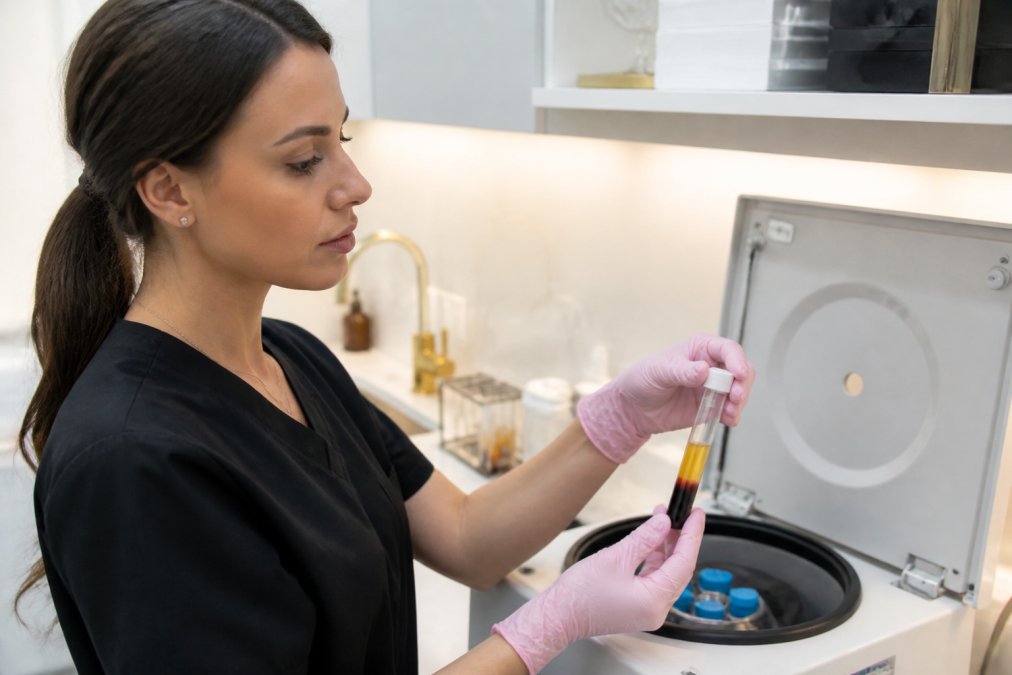
PRF (platelet-rich fibrin) and PRP (platelet-rich plasma) both use a sample of your own blood, spun in a centrifuge to concentrate platelets and growth factors, then reintroduced into the skin. The difference lies in what else survives the spin.
PRP is prepared with an anticoagulant, so it stays liquid and releases its growth factors in a relatively short burst after injection.
The Biological Mechanism, Simplified
Growth factors such as platelet-derived growth factor (PDGF), transforming growth factor beta (TGF-β), vascular endothelial growth factor (VEGF) and insulin-like growth factor (IGF-1) are signalling proteins. They do not bleach pigment directly. Instead, they bind to receptors on fibroblasts, keratinocytes and endothelial cells and prompt a cascade of downstream responses:
- Fibroblasts are stimulated to produce new collagen and elastin, rebuilding the dermal matrix that gives skin its even, light-reflecting surface.
- Keratinocytes are encouraged to turn over at a normal, controlled rate, which helps shift pigment-laden cells upward and out without triggering the inflammation that drives rebound pigmentation.
- Endothelial cells support new capillary formation, improving the delivery of oxygen and nutrients to a dermal environment that has often been chronically inflamed.
- Inflammatory signalling, the pathway that keeps melanocytes overactive in melasma and post-inflammatory hyperpigmentation, is modulated rather than amplified. This is the key distinction from ablative approaches, which deliberately wound the skin and can provoke a pigment response in susceptible phototypes.
Practical Differences That Matter
| Feature | PRP | PRF |
|---|---|---|
| Preparation | Anticoagulant added | No anticoagulant |
| Consistency | Liquid | Fibrin gel |
| Release profile | Short burst | Gradual, over days |
| Growth factor retention | Lower | Higher, held in matrix |
| Best suited to | Texture, early rejuvenation | Gradual tone correction, sensitive or reactive skin |
A common mistake is assuming more sessions of a faster-acting treatment beats fewer sessions of a slower one. In practice, the gradual release suits the slow biology of pigment correction.
Australian Health Practitioner Regulation Agency guidance on cosmetic procedures
PRF’s advantage is not that it is stronger than PRP, it is that it releases growth factors more slowly and provides a fibrin scaffold that keeps them where they are needed. For pigmentation, slow and sustained usually beats fast and aggressive.
How Long Does PRF Treatment Take?
A PRF treatment session typically takes 45 to 60 minutes from start to finish, including the blood draw, preparation, and application. The consultation and mapping stage adds time on your first visit.
Book your first session with buffer time around it. The blood draw and centrifugation add 15 to 20 minutes that most people don’t factor in, and rushing the preparation stage helps no one.
Post-Treatment Care for Regenerative Skin Therapy
Post-treatment care decides how well your results hold. Most guides stop at the first 72 hours. In practice, the habits you keep over the following 12 months determine whether pigment returns, and this is the part most patients are never given a plan for.
The First 72 Hours
- Sun protection: daily broad-spectrum SPF 50+, reapplied every two hours if outdoors. UV exposure in the first days after treatment is the single most common trigger for rebound pigment.
- Gentle cleansing: a mild, fragrance-free cleanser only. No exfoliating acids, no retinoids, no vitamin C for at least 72 hours unless your clinician advises otherwise.
- Hydration: a simple, fragrance-free moisturiser supports barrier recovery. Avoid introducing new active ingredients during this window.
- Heat avoidance: skip saunas, hot yoga, steam rooms and intense exercise for 48 hours. Heat increases blood flow and can amplify post-treatment inflammation.
- No picking: pinpoint marks from needling settle on their own. Picking introduces inflammation, which is exactly what drives post-inflammatory hyperpigmentation.
Weeks 1 to 4: Consolidation
This is when the regenerative signalling is still active beneath the surface. Keep the routine simple: sunscreen, gentle cleansing, moisturiser. If your clinician clears it, a low-strength niacinamide or azelaic acid can be reintroduced around week two to support even tone without provoking irritation. Avoid strong retinoids and high-concentration acids until at least week four.
Months 2 to 6: Building the Result
Most clients need a series of sessions spaced four to six weeks apart. Between sessions, the goal is to protect what has been built. A practical framework:
- Morning: broad-spectrum sunscreen, reapplied through the day. This is non-negotiable for anyone with a history of melasma or photodamage.
- Evening: a barrier-supporting moisturiser, plus a pigment-modulating active such as niacinamide, azelaic acid or tranexamic acid if tolerated and approved by your clinician.
- Trigger management: if your pigmentation is hormonal, discuss this with your clinician or GP. Topical and procedural treatment will not override an ongoing hormonal driver.
- Review: a clinical review at the end of the series to assess response and decide whether maintenance is needed.
Months 6 to 12: The Maintenance Protocol Most Guides Skip
Pigmentation is a chronic, relapsing condition for many people. Treating it as a one-off procedure is why it returns. A structured 12-month maintenance plan looks like this:
| Period | Focus | Typical action |
|---|---|---|
| Months 1-3 | Active treatment series | Sessions spaced 4-6 weeks |
| Months 4-6 | Consolidation | Topical pigment modulators, strict photoprotection |
| Months 7-9 | Review and stabilise | Clinical review; single maintenance session if indicated |
| Months 10-12 | Prevention | Ongoing photoprotection, trigger management, annual review |
The Non-Negotiables
Regardless of where you are in the timeline, three things protect your result more than any single product or procedure:
- Daily broad-spectrum sunscreen, reapplied. This is the foundation of every pigmentation plan.
- Trigger awareness. Know whether your pigment is UV-driven, hormonal, or inflammatory, and manage that driver.
- Patience with actives. Resuming strong retinoids or acids too soon is a common cause of setback. Wait until your clinician clears you.
Cancer Council Australia sun protection guidance
Comparing Regenerative and Traditional Laser Approaches
Regenerative and traditional laser approaches differ in how aggressively they treat pigment and how much downtime they involve. Fractional laser and fractional resurfacing use laser energy to target pigment and stimulate renewal, with non-ablative options offering less downtime than ablative ones.
| Approach | Mechanism | Downtime | Best For |
|---|---|---|---|
| Regenerative (PRF) | Growth factors, biostimulation | Minimal | Gradual tone correction, sensitive skin |
| Non-ablative fractional laser | Controlled heat, dermal remodeling | 2-4 days | Texture and mild pigment |
| Ablative resurfacing | Removes outer layers | 1-2 weeks | Significant photodamage |
| Chemical peels | Exfoliating agents, epidermal turnover | 3-7 days | Surface pigment |
Is Regenerative Skin Therapy Right for Your Skin?
Regenerative skin therapy suits clients whose pigmentation is driven by inflammation, photodamage, or hormonal fluctuation, and who prefer gradual improvement over aggressive intervention. It’s less suited to very deep dermal pigment, which may need a combined approach.
Therapeutic Goods Administration guidance on aesthetic treatments
Frequently Asked Questions
Which therapy is best for pigmentation?
The best therapy depends on your pigmentation type and skin phototype. Regenerative options like PRF and exosomes support dermal repair and can be combined with non-ablative fractional resurfacing. A consultation with a Registered Nurse can map your melanin and recommend a personalised plan. No single treatment suits everyone.
Is regenerative skin therapy suitable for melasma?
Regenerative skin therapy can be suitable for melasma, but it requires careful assessment. Melasma often involves overactive melanocytes and a compromised skin barrier. Treatments like PRF or low-energy laser can help, but high-energy resurfacing may worsen it. A clinician experienced with melasma should tailor the approach.
How many sessions are typically required to see results in pigmentation reduction?
Most people need a series of sessions. For PRF or exosome therapy, three to four sessions spaced four to six weeks apart is common. Results build gradually as collagen remodels and epidermal turnover improves. Maintenance sessions every six to twelve months help sustain results. Your clinician will adjust based on your response.
What are the primary benefits of using PRF for skin rejuvenation?
PRF releases growth factors gradually, supporting collagen induction and skin renewal. It can improve skin texture, tone uniformity, and overall dermal repair. Unlike PRP, PRF contains fibrin and leukocytes, which may enhance healing. It is also autologous, meaning it uses your own blood, reducing allergy risk.