
Table of Contents
- What Makes an Aesthetic Treatment Worth It?
- Non-Invasive vs Surgical: A Cost-Benefit Breakdown
- Why Aesthetic Clinic Pricing Varies
- How to Choose a Cosmetic Clinic You Can Trust
- Non-Surgical Facial Rejuvenation Recovery Time
- The Psychological Impact: Hype vs Reality
- Frequently Asked Questions
Last Updated: September 22, 2026
What Makes an Aesthetic Treatment Worth It?
Aesthetic treatments are worth it when the clinical result matches a goal you defined beforehand, the downtime fits your schedule, and the monthly maintenance cost feels reasonable. That three-part test separates satisfied patients from disappointed ones more reliably than any before-and-after photo. Here’s how to run it on any treatment.
Defining Your Aesthetic Goals
Vague goals produce vague results. “Looking fresher” is not a goal; “softening the two frown lines between my brows so I stop looking annoyed in photos” is, because you can measure it afterwards. Write your goal down before your consultation, then ask:
- What specifically bothers me, and when did I start noticing it?
- Do I want to prevent something, correct something, or both?
- What result would make me feel this was money well spent?
The Evidence-Based Worth It Framework
Score each treatment from 1 to 5 on four criteria, then add the totals:
| Criterion | Score 1-5 | What a 5 Looks Like |
|---|---|---|
| Goal match | 1-5 | Directly addresses your stated concern |
| Evidence strength | 1-5 | Well-documented clinical results in peer-reviewed literature |
| Downtime fit | 1-5 | Recovery period suits your work and social calendar |
| Maintenance cost | 1-5 | Ongoing cost and frequency feel sustainable for years |
The highest-scoring treatment is not always the most dramatic one. Preventative treatments that score well on downtime and maintenance often beat aggressive procedures that score badly on both.
Non-Invasive vs Surgical: A Cost-Benefit Breakdown
Non-invasive treatments win on downtime and reversibility; surgery wins on longevity. Non-surgical options, anti-wrinkle injections, dermal fillers, laser resurfacing, chemical peels, skin needling, involve minimal downtime, work gradually, and need repeating. Surgery such as facelifts or blepharoplasty lasts longer but carries anaesthetic risk, real recovery time, and a much higher upfront cost. The question isn’t which is better, but whether the concern justifies surgery or a staged plan of non-invasive treatments gets you close enough.
Popular Treatments and Their Clinical Results
Anti-wrinkle injections relax specific muscles to soften dynamic lines, appearing over several days and needing refreshment every few months. Dermal fillers restore volume and improve contour, visible immediately and lasting months to over a year. Laser resurfacing targets texture, pigmentation, and sun damage via collagen production, building over weeks. Chemical peels range from light exfoliation to deeper resurfacing, with depth determining downtime and effect. PRP and PRF use your own blood components for skin rejuvenation and hair thinning, building across a series of sessions.
| Treatment | Typical Downtime | Results Build | Maintenance Needed |
|---|---|---|---|
| Anti-wrinkle injections | Minimal | Days | Every few months |
| Dermal fillers | Days | Immediate | Months to a year |
| Laser resurfacing | Days to a week | Weeks | Periodic sessions |
| Chemical peels | Days | Weeks | Periodic sessions |
| PRP / PRF | Minimal | Weeks | Series, then maintenance |
Why Aesthetic Clinic Pricing Varies
Two clinics can quote very different figures for the same treatment name, and the gap comes down to four things: who performs it, what product is used, how much time is booked, and what’s included afterwards. A Registered Nurse or doctor-led clinic carries different overheads than one where treatments are delegated, and a premium brand of botulinum toxin or filler costs more than a budget equivalent.
The Total Cost of Ownership Framework
For any repeat treatment, you need four inputs:
- Cost per session, the full amount you pay, including consultation if charged separately.
- Sessions per year, how many times you need the treatment to maintain the result.
- Touch-up probability, the realistic chance you’ll need an extra appointment within the first month (higher for lips, lower for forehead lines).
- Review and aftercare costs, whether follow-ups, complication management, or corrective work are included or billed.
The formula is simple:
Annual cost = (cost per session × sessions per year) + (cost per session × touch-up probability × sessions per year) + annual review costs
Worked Examples (Illustrative)
These are illustrative figures showing the method, not quotes. Substitute your own clinic’s numbers.
Example A, Anti-wrinkle injections, forehead and frown lines
- Cost per session: $400
- Sessions per year: 3 (every four months)
- Touch-up probability: 10%
- Review costs: $0 (included)
Example B, Dermal fillers, cheeks
- Cost per session: $900
- Sessions per year: 1 (product lasts 12-18 months, so some years are zero)
- Touch-up probability: 20%
- Review costs: $0
Example C, Laser resurfacing for pigmentation
- Cost per session: $600
- Sessions per year: 2 (initial course then maintenance)
- Touch-up probability: 0%
- Review costs: $80 per review, two per year
A $400 treatment every four months and a $900 treatment once a year can have almost identical monthly costs. Comparing headline prices hides that. Compare monthly maintenance cost instead.
The Five-Year View
Most people considering aesthetic treatments think in single appointments; clinicians think in cycles. A treatment you start at 35 and maintain until 45 is a ten-year commitment, not a one-off purchase. Before starting any repeat treatment, ask:
- Can I sustain this monthly cost for at least three years without resentment?
- If my income dropped by 20%, would I keep this or drop it?
- Am I treating a concern that will still matter to me in five years, or one that is tied to a current event?
Cheap isn’t the same as good value, and expensive isn’t the same as safe. The number that matters is cost per month of maintained result, not the price of a single appointment. A cheap treatment that needs correcting is the most expensive option of all.
Budget-Friendly Options That Still Score Well
If the total cost of ownership is out of reach, several lower-cost options deliver genuine value:
- A consistent skincare routine with prescription retinoid and daily SPF, the highest evidence-to-cost ratio in the field, and the foundation any clinician will recommend before injectables.
- Anti-wrinkle injections at a lower dose, less frequently, softening rather than freezing, reducing both cost and the ‘done’ look.
- Skin needling instead of laser for texture and scarring, slower results, but a fraction of the cost and downtime.
- Staged treatment plans, spreading treatments across 12-18 months rather than front-loading them, which smooths the monthly cost and lets you assess results before committing further.
How to Choose a Cosmetic Clinic You Can Trust
Choose a clinic on qualifications, consultation quality, and honesty about risks, in that order. Price comes fourth.
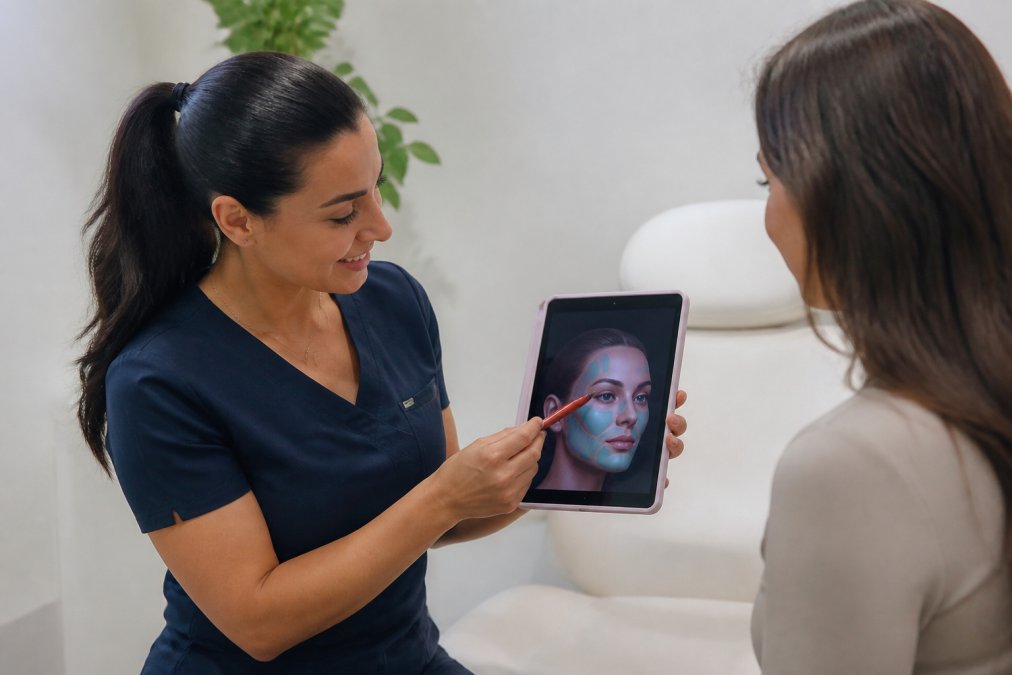
Run this checklist before you book:
- Confirm who will perform the treatment and their registration or nursing credentials
- Ask what products they use and whether they’re approved for use in Australia
- Ask what can go wrong, and how complications are managed
- Ask whether a review appointment is included
- Check whether the consultation feels like a sales pitch or a clinical assessment
Non-Surgical Facial Rejuvenation Recovery Time
Downtime is the most under-estimated part of the worth-it calculation. Most non-surgical facial rejuvenation involves downtime measured in hours to days, not weeks, but the range is wide enough that treating ‘non-surgical’ as one category will catch you out. The table below breaks down each treatment so you can plan around your calendar.
| Treatment | Day 0 (treatment day) | Days 1-3 | Days 4-7 | Return to normal |
|---|---|---|---|---|
| Anti-wrinkle injections | Small raised bumps at injection points, settle within 1-4 hours | Possible mild headache or heaviness in the treated area | Usually nothing visible | Same day |
| Dermal fillers | Swelling, possible pinpoint bruising | Swelling peaks at 24-48 hours, then resolves | Bruising may fade through yellow-green | 2-5 days for most areas; lips can take longer |
| Skin needling | Redness like mild sunburn | Redness fades, skin may feel tight | Possible light flaking | 1-3 days |
| PRP / PRF | Redness and mild swelling | Swelling settles, possible bruising at draw site | Skin looks settled | 1-2 days |
| Light chemical peel | Mild warmth and pinkness | Light flaking begins | Flaking completes | 3-5 days |
| Medium chemical peel | Noticeable redness, possible swelling | Peeling begins, skin feels tight | Peeling mostly complete | 5-7 days |
| Laser resurfacing (ablative) | Significant redness, oozing possible | Redness persists, skin begins to re-epithelialise | Peeling and pinkness | 7-14 days, with residual pinkness for weeks |
A few practical rules experienced clinicians repeat:
- Buffer two weeks, not two days. A Thursday filler appointment before a Saturday wedding is a poor decision; for laser or medium peels, three to four weeks is wiser before a fixed event.
- Bruising risk is not random. Blood-thinning medications, fish oil, high-dose vitamin E, alcohol in the 24 hours before treatment, and a history of easy bruising all raise your odds. Tell your clinician what you take.
- Social downtime often outlasts clinical downtime. You may be clinically healed before you feel comfortable being photographed, factor that in if your concern is how you look on camera.
- Aftercare is not optional. For skin needling and PRP, expect mild redness for a day or two and briefly avoid intense exercise, saunas, and swimming. Sun protection is non-negotiable for any resurfacing treatment, unprotected UV exposure after a peel or laser can cause post-inflammatory hyperpigmentation, harder to treat than the original concern.
Downtime is not a sign of a ‘stronger’ treatment. A treatment that produces dramatic results but wipes out two weeks of your calendar may score lower on the worth-it framework than a gentler option you can repeat consistently.
Age-Specific Recovery: Why the Same Treatment Hits Differently at 25 and 55
Recovery time isn’t fixed by the treatment alone, it’s shaped by your skin’s baseline healing capacity, which changes with age, sun history, and general health. A common pattern:
- In your twenties and thirties, skin typically rebounds faster. Redness and swelling from fillers or needling often resolve in half the time an older patient experiences.
- In your forties and fifties, collagen turnover slows and barrier function is less resilient. The same medium peel that flaked for five days at 30 may flake for seven to ten at 50, and post-inflammatory hyperpigmentation risk rises.
- After menopause, declining oestrogen reduces skin thickness and wound-healing speed, which can extend downtime for resurfacing treatments.
The Psychological Impact: Hype vs Reality
The strongest predictor of satisfaction isn’t the treatment, it’s the gap between expectation and result, and social media widens that gap. Filters and heavily edited before-and-after content create a benchmark no clinic can meet, driving people toward repeated treatments they don’t need. This is where body dysmorphic disorder matters, and most clinic marketing ignores it. If a concern occupies hours of your day, if you check it repeatedly in mirrors or photos, or if you’ve had treatments and still feel unchanged, more treatment is not the answer.
Ask a trusted friend or family member whether your concern is something they notice. If they’re surprised you’re considering treatment, that’s useful information about how visible the issue actually is.
Frequently Asked Questions
How long do aesthetic treatments typically last?
Results vary by treatment type. Botulinum toxin usually softens lines for three to four months, while dermal fillers can last six to eighteen months depending on the product and area. Laser resurfacing and chemical peels deliver gradual improvements over several sessions. Your maintenance schedule will depend on your treatment plan, skin condition and aesthetic goals, so a consultation is the best way to get an accurate timeline.
How do I know if a cosmetic clinic is reputable and safe?
Check that the clinic is led by registered healthcare professionals, such as Registered Nurses or doctors, and that they operate under the standards set by the Australian Health Practitioner Regulation Agency (AHPRA). Look for a thorough consultation process, clear information about risks and aftercare, and evidence of ongoing training. A reputable clinic will never pressure you into treatment and will explain your options honestly.
What is the most sought-after aesthetic treatment?
Non-invasive options like anti-wrinkle injections and dermal fillers remain the most requested treatments for facial rejuvenation. Laser therapies and skin needling are also popular for improving skin texture, pigmentation and collagen production. The best treatment for you depends on your concerns, whether that is volume loss, fine lines or uneven skin tone, and should be determined during a personalised consultation.
How can I effectively address signs of ageing with non-surgical treatments?
A combination approach often works best. Preventative treatments such as botulinum toxin can soften dynamic lines, while dermal fillers restore volume lost over time. Laser resurfacing and chemical peels improve skin texture and hyperpigmentation. Your clinician may recommend a customised treatment plan that layers these options gradually to maintain natural-looking results and support long-term skin health.