
Table of Contents
- Botox vs Dysport: Quick Comparison Table
- What Are Neuromodulators and How Do They Work?
- Onset of Action: When Results Appear
- How Long Does Botox Last for Frown Lines Compared to Dysport
- Diffusion and Spread: Precision vs Coverage
- Cost of Anti-Wrinkle Injections and What Affects Pricing
- TGA Regulations for Cosmetic Injectables and Safety Profile
- Choosing a Qualified Cosmetic Nurse Injector
- Frequently Asked Questions
Last Updated: September 27, 2026
Botox vs Dysport: Quick Comparison Table
| Feature | Botox | Dysport | Winner |
|---|---|---|---|
| Onset of Action | 3-7 days | 2-3 days | Dysport |
| Peak Results | 2 weeks | 5-7 days | Dysport |
| Duration | 3-4 months | 3-4 months | Tie |
| Diffusion Profile | Precise, localised | Broader spread | Botox (precision) / Dysport (coverage) |
| Units Required | Fewer per treatment | More per treatment | Botox |
| Best For | Targeted frown lines | Larger treatment areas | Context-dependent |
| TGA Approval | Yes | Yes | Tie |
When considering Botox vs Dysport for frown lines 2026, the choice comes down to how quickly you want results and how much coverage you need. Both neuromodulators work by blocking nerve signals that cause facial muscle contractions, but they differ in onset speed, diffusion pattern, and practical considerations. At BLC Aesthetics, we help patients understand these differences to choose the treatment that matches their goals and lifestyle.
What Are Neuromodulators and How Do They Work?
Neuromodulators are prescription-only injectable medications that relax facial muscles by blocking acetylcholine release, a neurotransmitter that signals muscle contraction. When this signal is interrupted, the muscle relaxes and overlying skin smooths.
Both Botox (onabotulinumtoxinA) and Dysport (abobotulinumtoxinA) are derived from the same bacterial source but formulated differently, affecting onset speed and spread. Glabellar lines (vertical frown lines between eyebrows) are a primary treatment area because they result from repeated muscle contraction over decades.
Both bind to nerve endings to prevent contraction, but differ in protein structure and molecular weight. Botox’s complexing proteins slow onset but provide precise control; Dysport’s fewer accessory proteins allow faster diffusion. Precision matters for targeted small areas; diffusion suits broader regions.
The “units” you hear about in pricing aren’t standardised across products. Dysport typically requires more units than Botox for equivalent results, roughly 3 units of Dysport to every 1 unit of Botox. This affects the cost calculation significantly.
Onset of Action: When Results Appear
Dysport delivers visible softening within 2-3 days, while Botox typically takes 3-7 days to show initial results. However, this timeline varies significantly between individuals based on metabolism, muscle physiology, and injection technique. Understanding your personal response pattern is crucial for realistic expectations.
Why Onset Timing Varies Between Patients
The published timelines (Dysport 2-3 days, Botox 3-7 days) represent population averages, not guarantees. Several physiological factors determine how quickly you will see results:
Metabolic rate and enzyme activity: Acetylcholinesterase activity determines how quickly your body processes the neurotoxin. Faster metabolism may produce Dysport results within 24-48 hours; slower metabolism may delay results until day 5-7.
Muscle mass and fibre composition: Larger facial muscles require more time for full paralysis. Patients with pronounced glabellar musculature may experience onset 2-3 days later than those with lighter muscle tone.
Injection depth and placement precision: Shallow or off-target injections delay onset because toxin must diffuse further to reach intended muscle fibres. Experienced injectors deliver faster, more predictable results.
Prior treatment history: Repeat patients see faster onset because muscles are already partially atrophied from previous treatments. First-time patients typically experience slower onset.
Dysport vs Botox: Onset in Practice
Dysport often shows improvement by day three, with peak results by day five to seven. This faster onset appeals to those with upcoming events, though individual metabolism determines actual speed.
Botox takes 3-5 days for initial softening, with full results by two weeks. The slower onset correlates with more controlled, precise results. For slower-metabolism patients, onset differences may be negligible, making diffusion pattern and precision the deciding factors.
Predicting Your Personal Onset Timeline
During consultation, discuss your metabolism and prior treatment response. Prior onset timing is the most reliable predictor of future response. First-time patients should ask about typical timelines and anatomical factors affecting personal response.
If you’re planning treatment for a specific event, book your injection 10-14 days in advance. This window accommodates slower-onset patients (Botox responders) whilst giving faster-onset patients (Dysport responders) time to reach peak results. Avoid injecting fewer than 5 days before an important occasion unless you’ve had the same product before and know your personal onset is rapid.
How Long Does Botox Last for Frown Lines Compared to Dysport
Both Botox vs Dysport for frown lines 2026 deliver similar longevity: typically 3-4 months of visible improvement. After this window, muscle activity gradually returns, and frown lines reappear. However, individual duration varies widely, and long-term users face a clinical reality competitors rarely discuss: antibody resistance and the need for product rotation.
Duration in the First Year: Individual Variation
The 3-4 month timeline represents the median duration across most patients, but the range is substantial. Some people maintain visible improvement for 10-12 weeks, whilst others sustain results for 16 weeks or longer. Factors affecting longevity include:
Muscle mass and strength: Stronger muscles metabolise neurotoxin faster. Patients with prominent corrugator supercilii muscles see frown lines return at 10 weeks; lighter muscle tone maintains smoothness until week 16.
Baseline metabolic rate: Faster metabolism shortens duration; slower metabolism extends results.
Dosage and injection technique: Adequate units placed precisely into the motor endplate ensure longer results. Under-dosing causes incomplete paralysis and shorter duration.
Repeat treatment frequency: Consistent treatments may extend duration as muscles gradually atrophy. Irregular schedules may shorten duration on subsequent treatments.
Product choice: Dysport and Botox show similar median duration (3-4 months), but individual response varies. Your practitioner can help identify which delivers longer results for your anatomy.
The Long-Term Reality: Antibody Resistance and Product Rotation
For patients receiving regular neuromodulator treatments over 2-3 years or longer, a critical clinical issue emerges: antibody formation. A subset of patients (estimated 5-15% of long-term users) develop neutralising antibodies against the neurotoxin (Checking your browser). These antibodies bind to the injected product and render it ineffective, causing results to fade faster or disappear entirely.
Antibody resistance typically manifests as gradually shortening duration, delayed or absent onset, or loss of response despite higher doses.
Antibody formation is more common with high cumulative doses, longer treatment duration (5+ years), genetic predisposition, and repeated use of the same product without rotation.
Product rotation minimises antibody resistance. Switching between Botox and Dysport for 1-2 cycles can restore responsiveness because antibodies developed against one product often do not cross-react with the other.
Discuss this strategy with your practitioner if you’re a long-term user.
Planning for Long-Term Maintenance
For most patients, four treatments per year (every 3 months) maintains frown line improvement. Some practitioners recommend scheduling at 10 weeks to maintain continuous smoothness and prevent full muscle reactivation.
Neither Botox nor Dysport offers permanent results. Both require ongoing maintenance to sustain frown line improvement, typically 4 treatments annually. Long-term users (2+ years) should be aware of antibody resistance and discuss product rotation strategies with their practitioner to maintain efficacy over time.
Diffusion and Spread: Precision vs Coverage
The diffusion profile is where Botox vs Dysport for frown lines 2026 diverge most meaningfully. Botox stays tightly localised to the injection site, while Dysport spreads more broadly through surrounding tissue.
Cost of Anti-Wrinkle Injections and What Affects Pricing
Pricing for Botox vs Dysport for frown lines 2026 varies based on several factors. Both products are priced per unit, but the cost per unit differs, and the number of units required varies between them.
Beware of clinics offering significantly lower prices than competitors. Underpricng often signals inadequate training, diluted product, or cost-cutting on safety protocols. Aesthetic treatments require precision and expertise, the cheapest option is rarely the safest.
TGA Regulations for Cosmetic Injectables and Safety Profile
In Australia, both Botox and Dysport are TGA-regulated prescription-only medicines, administered only by qualified practitioners: doctors, nurse practitioners, or Registered Nurses under medical supervision.
Potential side effects to discuss with your practitioner:
- Temporary bruising or swelling (resolves within days)
- Mild headache (usually transient)
- Eyebrow or eyelid drooping (ptosis) if injected incorrectly
- Asymmetry if dosing is uneven
- Allergic reaction (extremely rare)
Choosing a Qualified Cosmetic Nurse Injector
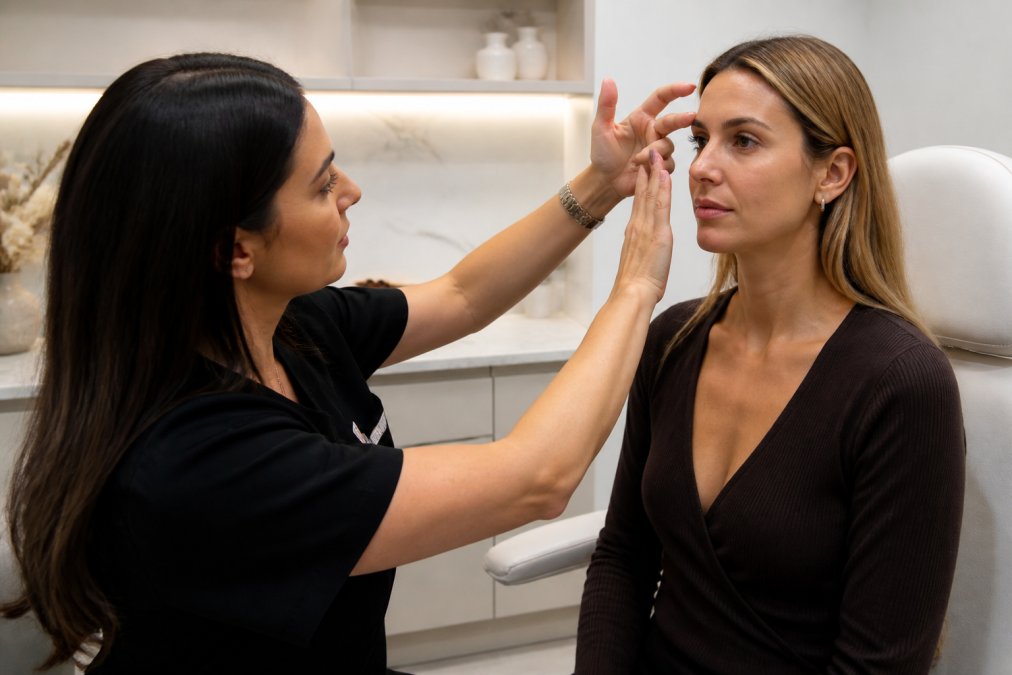
The difference between a good aesthetic outcome and a poor one depends far more on injector skill than on which product you choose. A highly trained practitioner using Botox or Dysport will deliver better results than an under-trained injector using either product.
Red flags to avoid:
- Practitioners who won’t discuss risks or side effects
- Clinics offering suspiciously low prices
- Lack of proper medical supervision or regulatory compliance
- Unwillingness to provide qualifications or training details
- High-pressure sales tactics
Frequently Asked Questions
Is Dysport or Botox better for treating frown lines?
Neither is universally ‘better’, it depends on your goals. Botox offers precision and predictability, making it ideal for isolated frown lines where you want controlled results. Dysport spreads more broadly and works faster, suiting those who want quicker visible softening across a larger area. A qualified cosmetic nurse can assess your facial anatomy and recommend which neuromodulator aligns with your aesthetic outcome.
How long does Botox last for frown lines compared to Dysport?
Both typically last 3 to 4 months. Results begin to fade gradually as your body metabolises the neurotoxin and acetylcholine production resumes. Individual metabolism varies, so some patients maintain results for 12 weeks while others see fading by week 10. Dysport may show earlier onset but similar longevity. Your cosmetic nurse can discuss maintenance schedules during your consultation.
What affects the cost of anti-wrinkle injections in Australia?
Pricing depends on the number of units required, the product chosen, clinic location, and practitioner experience. Dysport typically requires more units than Botox for equivalent coverage due to diffusion differences. Clinics with Registered Nurse-led care and established safety records often reflect that expertise in their pricing. Contact your chosen clinic for a personalised quote based on your specific treatment area.
Why do people prefer Dysport over Botox for frown lines?
Some prefer Dysport for its faster onset (visible softening within 2-3 days versus 5-7 days for Botox) and broader spreadability, which suits larger treatment areas. Others appreciate its natural-looking movement profile. However, those seeking high precision for isolated glabellar lines often choose Botox. Preference is individual and depends on your metabolism, facial anatomy, and aesthetic priorities.
What qualifications should I look for in a cosmetic nurse injector?
Ensure your injector is a Registered Nurse with formal training in facial anatomy, injection technique, and neuromodulator pharmacology. Verify they work under medical oversight and follow TGA regulations for cosmetic injectables. Check their experience with frown line treatment, ask about their safety protocols, and review before-and-after portfolios. A thorough consultation where they listen to your goals signals professional practice.