

Table of Contents
- PRP for Hair Loss: What the Treatment Actually Involves
- How Many PRP Sessions for Hair Loss Do You Really Need?
- The Benefits of PRF Over PRP: Does the Newer Option Change the Verdict?
- PRP Hair Treatment Cost in Australia: What You Are Actually Paying For
- Effectiveness, Side Effects and Who Should Avoid PRP
- Long-Term Maintenance and Lifestyle Factors That Decide Your Results
- Conclusion: Is PRP for Hair Loss Worth It for You?
- Frequently Asked Questions
Last Updated: September 16, 2026
PRP for Hair Loss: What the Treatment Actually Involves
If you are asking yourself is PRP for hair loss worth it, the short answer is that it depends less on the treatment itself and more on your hair loss pattern, your expectations and your willingness to commit to ongoing sessions. At BLC Aesthetics, our Registered Nurses assess suitability before recommending any regenerative hair treatment, because results vary widely between patients.
How the procedure works, step by step
- A small blood sample is drawn, similar to a routine pathology test.
- The sample is spun in a centrifuge to separate platelet-rich plasma from red blood cells.
- The scalp is cleaned and a local anaesthetic cream is applied to reduce discomfort.
- The plasma is injected into areas of thinning using fine needles, targeting the dermal papilla at the base of each follicle.
- The appointment typically takes under an hour, and most people return to normal activity the same day.
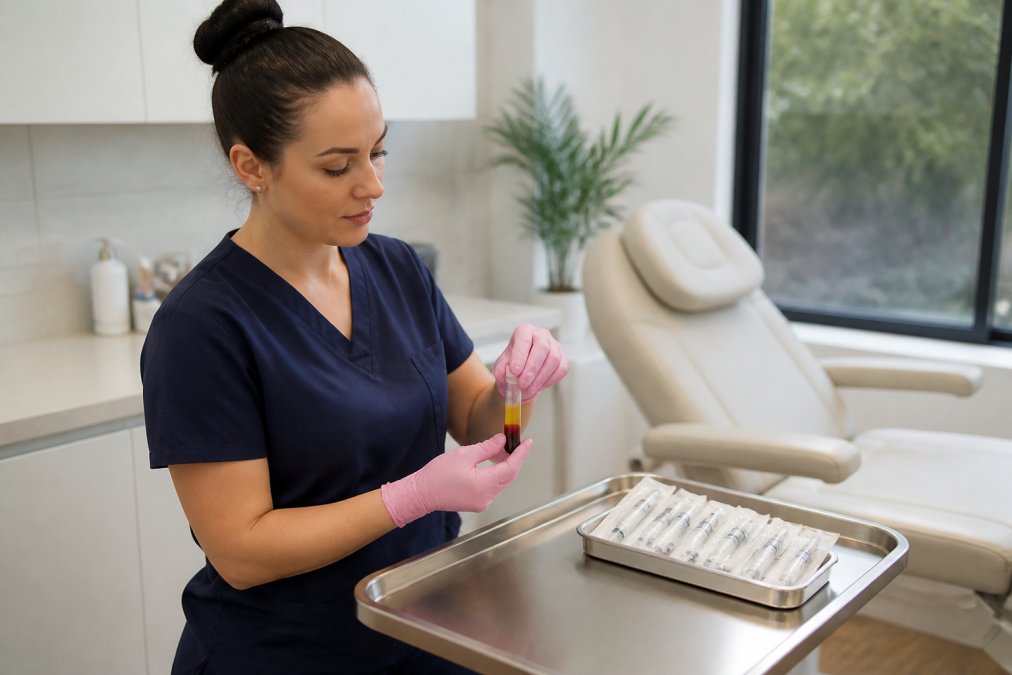
Why two PRP treatments with the same name can produce different results
This is the part most clinic websites leave out, and it is the single best explanation for the inconsistent results people report online. “PRP” is not one standardised product. It is a category of preparations, and the platelet concentration in the final syringe can vary several-fold between clinics, and even between kits used in the same clinic.
Three variables drive that variation:
- The kit or system used. Closed systems that draw and process blood in a single sterile tube tend to produce a more consistent platelet yield than open systems where the sample is transferred between containers. Some kits are also formulated to produce leucocyte-poor plasma, which some clinicians prefer for scalp injections.
- Centrifuge speed and time. Platelets separate from red cells at a specific gravitational force and duration. Spin too slowly and you leave platelets behind in the red cell layer; spin too fast and you can damage the platelets, reducing the growth factors they release. A clinic using a fixed-speed centrifuge for every patient is not adjusting for individual blood characteristics.
- Baseline platelet count. A patient with a naturally low platelet count will produce a lower-concentration sample from the same protocol. This is one reason some patients respond and others do not, even with identical treatment plans.
PRP is not a single standardised product. The kit, the centrifuge protocol and your own baseline platelet count all influence how much active growth factor reaches the follicle. This is the main reason two patients with similar hair loss can get very different results.
What the injection actually targets
Each injection is placed at the level of the dermal papilla, the small structure at the base of the follicle that supplies it with blood and signals. The goal is not to flood the scalp with plasma but to deliver a concentrated dose directly to the structures that regulate the hair growth cycle. Injections are typically spaced roughly a centimetre apart across the thinning area, which is why the number of injections, and the time the appointment takes, scales with the size of the treatment zone.
How Many PRP Sessions for Hair Loss Do You Really Need?
Most clinics recommend an initial course of three sessions, spaced roughly four to six weeks apart, followed by maintenance sessions every three to six months. This is the single most common question we field, and the honest answer is that the initial course exists to establish whether your follicles respond at all.
The initial course and why three sessions is the usual starting point
One session rarely produces measurable change. Three gives the scalp enough stimulation across a full growth cycle to show whether regrowth is occurring. If there is no response after a completed course, additional sessions are unlikely to change that.
Skipping the initial three-session course and jumping straight to maintenance is a common mistake. A single session every few months does not build the cumulative stimulation that regrowth depends on.
The Benefits of PRF Over PRP: Does the Newer Option Change the Verdict?
PRF, or platelet-rich fibrin, is a related preparation that retains a fibrin scaffold alongside the platelets, releasing growth factors more gradually. The practical difference is that PRF may offer a slower, more sustained release, while PRP delivers a higher initial concentration.
PRP Hair Treatment Cost in Australia: What You Are Actually Paying For
PRP hair treatment cost in Australia varies by clinic, session count and whether you are quoted per session or as a package. Because pricing depends on your treatment plan, we recommend requesting a written quote after your consultation rather than comparing headline numbers online.
| What You Are Paying For | Why It Matters |
|---|---|
| Clinician time and assessment | Ensures correct diagnosis before treatment |
| Sterile consumables | Reduces infection risk |
| Centrifuge processing | Determines platelet concentration |
| Follow-up review | Confirms whether regrowth is occurring |
Effectiveness, Side Effects and Who Should Avoid PRP
PRP is not a cure, and the evidence base is mixed. Some controlled studies show measurable improvement in hair density and hair diameter in early-stage androgenetic alopecia; others show results close to placebo. This is why patient selection matters more than the marketing.
Realistic success rates and the limits of the evidence
Many practitioners report that roughly a third of patients see clear improvement, a third see modest change, and a third see little to none. If you are told to expect dramatic regrowth, be sceptical.
Contraindications and hair loss types where PRP is the wrong tool
PRP is generally not suitable for active scalp infection, certain blood disorders, or while taking anticoagulant medication. It is also the wrong tool for scarring alopecia, where the follicle has been permanently destroyed, and for advanced hair loss where follicles are no longer viable. If you are already using minoxidil or finasteride, PRP is often best considered as combination therapy rather than a replacement.
Long-Term Maintenance and Lifestyle Factors That Decide Your Results
Most articles stop at “you’ll need maintenance sessions.” That is not useful. What actually determines whether your results hold after year one is a specific booster schedule, a small number of modifiable lifestyle variables, and a way of measuring progress that does not rely on memory. This section covers all three, because it is the part of PRP that patients most often get wrong.
The booster schedule after your first year
The initial three-session course is designed to establish whether your follicles respond. Once they do, the goal shifts from stimulation to maintenance, and the schedule changes:
- Months 1-3: the initial course, typically three sessions spaced four to six weeks apart.
- Months 4-12: maintenance sessions every three to four months. This is the consolidation phase, where the cumulative effect is protected while the follicle cycle stabilises.
- Year 2 onward: most patients settle into a booster every four to six months. Some clinicians extend to twice yearly if density has been stable for 12 months or more; others keep the four-month interval indefinitely for patients with progressive androgenetic alopecia.
Stopping maintenance because your hair “looks fine now” is the most common reason patients lose the gains they paid for. PRP suppresses the visible progression of thinning; it does not switch off the cause.
Lifestyle factors that measurably influence your response
Between sessions, several modifiable variables affect how well the follicles respond to the growth factors you have just injected:
- Vitamin D status. Vitamin D is involved in the hair growth cycle, and deficiency is common in Australia despite the climate. A simple blood test through your GP will tell you where you stand; correcting a deficiency is a low-cost step that supports any hair treatment.
- Iron and ferritin. Low ferritin is a well-recognised contributor to diffuse thinning, particularly in menstruating patients. If your ferritin is at the bottom of the reference range, that is worth discussing with your GP before committing to a PRP course.
- Protein intake. Hair is largely protein. Chronic under-eating or very low-protein diets slow regrowth regardless of how many growth factors are injected.
- Smoking. Smoking impairs microcirculation, which works directly against the angiogenesis that PRP is trying to encourage. Patients who smoke typically see a blunted response.
- Sleep and stress. Both influence the hair cycle. Telogen effluvium triggered by illness, surgery or prolonged stress can mask or reverse PRP gains, and it is worth ruling out before attributing a poor result to the treatment itself.
How to actually measure whether it is working
- Take photos before your first session, in the same room, under the same lighting, with the same hair length and styling.
- Use the same angles each time: crown, frontal hairline, mid-scalp part, and both temples.
- Take them at the same time of day, ideally with hair freshly washed and dried the same way.
- Review at six months, not six weeks. Early change is difficult to see and easy to over-interpret.
Take standardised photos under the same lighting before your first session. Comparing them at six months is the only reliable way to judge whether the treatment is working for you, and it gives your clinician an objective record to adjust the booster schedule against.
Post-procedure recovery is short, most patients return to normal activity the same day, with only mild tenderness at the injection sites. The commitment, however, is long. PRP is best understood as an ongoing management plan for early-stage thinning, not a one-off purchase, and the patients who get the most from it are the ones who treat the booster schedule and the lifestyle variables as part of the treatment rather than optional extras.
Conclusion: Is PRP for Hair Loss Worth It for You?
PRP is worth it for some patients and a waste of money for others, and the deciding factors are hair loss stage, diagnosis and consistency. It is a commitment, not a one-off appointment, and it works best in early-stage thinning alongside a broader plan.
Frequently Asked Questions
Does PRP actually work to regrow hair?
PRP can improve hair density and thickness in some people, but it is not a guaranteed regrowth treatment. Industry clinical frameworks cited by the ISHRS report success rates of roughly 30 to 50 per cent, and results depend on your hair loss type, how early you start and your individual biology. It tends to work best for early to moderate androgenetic alopecia, where follicles are thinning rather than permanently dormant. If a clinic promises a full head of new hair, treat that claim with caution and ask what outcome data they track.
What are the disadvantages of PRP for hair loss?
The main drawbacks are cost, commitment and variable results. PRP hair treatment in Australia is usually priced per session, and a full course plus maintenance adds up over a year. Results are not guaranteed, and the published success range is wide. Scalp injections involve some discomfort, and mild swelling or tenderness for a day or two is common. PRP also does not address the underlying cause of androgenetic alopecia, so without maintenance sessions or combination therapy, gains can fade.
Is 2 sessions of PRP enough for visible results?
Two sessions is usually below the standard starting course. Most clinical protocols begin with three sessions spaced about four weeks apart, followed by maintenance visits. Some patients notice reduced shedding after two sessions, but visible changes in hair density and diameter typically appear later in the course. If a provider offers only two sessions, ask how they assess progress and what happens if you see no change, because stopping early often means paying for a partial result.
How long do the results of PRP hair treatment last?
Results are not permanent. Most protocols use an initial course of three sessions, then maintenance every three to six months to hold the gains. If you stop entirely, hair thinning usually resumes because PRP does not change the genetics behind androgenetic alopecia. Think of it as ongoing management rather than a one-off fix, similar in principle to how minoxidil or finasteride must be continued to keep working. Your clinician should map out a maintenance schedule before you begin.
Who is the ideal candidate for PRP hair therapy?
The strongest candidates are adults with early-stage hair loss and a confirmed diagnosis of androgenetic alopecia, where follicles are thinning rather than scarred or permanently dormant. A biopsy or clinical assessment helps confirm this. PRP is generally less useful for scarring alopecias, active scalp infections or certain autoimmune conditions, and it is not a treatment for hair loss caused by nutritional deficiency or thyroid problems without addressing those first. A consultation with a qualified professional is the only way to know which group you fall into.